

Canadian banks provide a diverse array of savings accounts. These are designed to meet various financial goals. From everyday savings to substantial wealth accumulation, options exist for every type of saver. Major financial institutions like TD Bank, RBC, BMO, Scotiabank, CIBC, and National Bank are key players. They offer accounts with tiered interest rates. These rates often improve when specific minimum balances are maintained. Linking accounts can also boost your earnings. Understanding these nuances is crucial for maximizing your savings.
Major Banks Overview: The Canadian Landscape
The Canadian banking sector is largely dominated by the "Big Five" banks. These are TD, RBC, BMO, Scotiabank, and CIBC. National Bank also holds a significant position, particularly in Quebec. Each of these institutions offers a range of high-interest savings accounts (HISAs). They also provide more basic savings options. A major advantage of banking with these institutions is the security offered by CDIC. The Canada Deposit Insurance Corporation protects eligible deposits up to $100,000 per depositor. This applies to each insured institution. Interest rates are heavily influenced by policies from the Bank of Canada. Regulatory oversight by OSFI ensures banks maintain prudent liquidity and capital rules.
Eligibility Criteria for Savings Accounts
Opening a savings account in Canada is generally straightforward. Applicants must be Canadian residents. They also need to be at least 18 years old. In some provinces, the age requirement is 19. A valid Social Insurance Number (SIN) is essential. Proof of identity and address is also required. Non-residents may qualify under certain conditions. This usually involves having a work permit or proof of income. Special considerations are often given to students, seniors, and youth. These groups may receive fee waivers or higher introductory rates. All banks are mandated to conduct anti-money laundering checks. This is in accordance with FINTRAC regulations. These checks ensure financial security and compliance.
HISA promo expiry watch - August 13, 2026
Promotional savings rates at Simplii and Tangerine typically revert to lower base tiers after 3–6 months. Calendar the expiry date when you open the account — set a reminder 30 days before to compare EQ Bank ({EQ_NOTICE30} notice), Neo or Wealthsimple Cash.
| Check | Why it matters | Action |
|---|---|---|
| Promo end date | Rate may drop >2 pts | Schedule transfer |
| CDIC category | $100k cap | Split if >$100k |
| Payroll DD rule | EQ 2.75% needs $2k/mo | Align with employer deposit |
| BoC next decision | July 15, 2026 MPR | Promos may reprice after |
With policy rate at {BOC_RATE}, banks compete on marketing spreads more than on overnight funding shocks — shop on ongoing rate, not only welcome bonuses.
Interest Rates and Fees: A Detailed Look
Interest rates for savings accounts in early 2026 vary significantly. Base tiers typically offer low rates, often between 0.01% and 0.05%. However, rates can tier up considerably for larger balances. Some accounts offer "bumps" for linking with other banking products. Monthly maintenance fees are common. These fees can often be waived. This usually requires maintaining a minimum balance or having specific banking relationships. It's important to review these conditions carefully. This ensures you avoid unnecessary charges. Rates are always subject to change based on market conditions.
| Bank | Key Account | Base Rate (APY) | High-Tier Rate | Monthly Fee | Waiver Conditions |
|---|---|---|---|---|---|
| TD Bank | Signature Savings / ePremium | 0.01-0.05% | Up to 2.75-4.00% ($100K+) | $5-$15 | $300+ balance; link checking; $10K+ for Signature |
| RBC | eSavings | 0.01% | Up to 2.50% promo tiers | $0 | No fee; balance-based bonuses |
| BMO | Savings Builder | 0.01-0.05% | Up to 2.50% ($50K+) | $0-$5 | Link chequing or $5K balance |
| Scotiabank | MomentumPLUS | 0.01% | Up to 2.75% ($250K+) | $0 | No fee; tiered on balance |
| CIBC | Tax Advantage Savings | 0.01% | Up to 2.00% promo | $0-$6.95 | $5K+ or student/senior |
| National Bank | High Interest eSavings | 0.025% | Up to 1.50% ($20K+) | $0 | Quebec-focused; no fee |
The Bank of Canada's key rate significantly influences these savings rates. In 2026, the key rate hovers around 3-4%. This directly affects the prime rate, which banks use as a reference. Consequently, savings account yields are indirectly tied to these central bank decisions. It is essential for consumers to regularly check official bank websites. This ensures they have the most current information. Rates can change frequently. Staying informed helps you make better financial decisions. High-tier rates are often promotional or require very large balances. Always read the fine print.
Comparison Table: Features Across Banks
While major banks offer security and branch access, their maximum rates often lag behind online-only competitors. For example, some online banks like EQ Bank may offer rates around 4%+. However, the big banks provide comprehensive services. These include in-person support and the ability to bundle products. Bundling can lead to fee waivers and other perks. This table summarizes key features for quick comparison. It helps highlight the differences in offerings. Consider your overall banking needs, not just the interest rate. Sometimes, the convenience and integrated services of a major bank outweigh a slightly lower interest rate.
| Feature | TD | RBC | BMO | Scotiabank | CIBC | National Bank |
|---|---|---|---|---|---|---|
| Max Rate | 4.00% bump | 2.50% | 2.50% | 2.75% | 2.00% | 1.50% |
| Min Balance for Rate | $5K | $0 | $5K | $0 | $5K | $20K |
| Transaction Limits | Unlimited transfers | 1 free/month | Unlimited | Unlimited | Unlimited | Unlimited |
| Mobile App Rating | High | High | High | High | High | Medium |
| Promo Periods | 3-6 months | Ongoing | Quarterly | Seasonal | Variable | Annual |
The maximum rates shown often include promotional offers. These promotions can be temporary. They might last for 3 to 6 months. After the promotional period, the rate typically reverts to a lower base rate. It's crucial to understand these terms. Some banks, like RBC, offer ongoing balance-based bonuses. Others, like Scotiabank, have seasonal or variable promotions. National Bank often focuses its high-interest offerings for residents of Quebec. Always verify the current promotional terms. This ensures you're getting the best deal for the long term. These details are important for accurate comparison.
Step-by-Step Application Process
Applying for a savings account is generally a simple process. First, compare rates across different bank websites. Aggregators like Ratehub.ca can also be very helpful. Once you choose a bank, visit their online portal. For example, navigate to td.com/ca/en/personal-banking. Then, select "Open Savings Account." The process typically guides you through several steps. This includes entering your personal information. These details include your name, date of birth, address, SIN, and employment information. You will also need to link a funding source. This could be an existing chequing account or an external bank account. Identity verification is a crucial step. This might involve uploading documents online. Alternatively, you may need a quick visit to a branch. Finally, fund your new account. Minimum funding amounts can range from $0 to $100. Approval for online applications is often very fast. It can take as little as 1-5 minutes. The entire process is designed for efficiency.
Required Documents for Account Opening
To open a savings account, you will need a few essential documents. These are primarily for identity verification. A valid government-issued ID is mandatory. This includes a passport, driver's license, or permanent resident card. You will also need proof of address. A utility bill, dated within the last three months, is commonly accepted. Your Social Insurance Number (SIN) is also required. For non-residents, an Individual Tax Number (ITN) may be accepted instead. If you plan to open a high-value account, typically over $100,000, proof of income might be requested. This ensures compliance with financial regulations. Having all these documents ready will streamline your application. It speeds up the verification process significantly.
Regulations Governing Canadian Savings Accounts
Several key regulatory bodies oversee Canadian savings accounts. The Canada Deposit Insurance Corporation (CDIC) is paramount. It insures eligible deposits up to $100,000 per depositor. This applies to each member institution. All major banks listed here are CDIC members. This provides a strong layer of protection for your savings. The Office of the Superintendent of Financial Institutions (OSFI) also plays a critical role. OSFI enforces capital adequacy rules. They ensure banks hold sufficient reserves against potential risks. This maintains the stability and soundness of the financial system. Finally, the Bank of Canada sets the overnight rate. This rate indirectly influences the interest yields on savings accounts. The prime rate, which banks use, is closely linked to the Bank of Canada's key rate. These regulations ensure a secure and stable banking environment for consumers. They protect your money and provide confidence in the system.
Pros
- CDIC protection up to $100,000
- Easy access to funds via branches and online
- No stock market volatility
- Tiered rates reward higher balances
- Ideal for emergency funds and short-term goals
Cons
- Low base interest rates (often below inflation)
- Opportunity cost compared to GICs or stocks
- Potential monthly fees if balance requirements not met
- Promotional rates can expire, reverting to lower yields
- Rates fluctuate with central bank policy
Expert Tips for Maximizing Savings
To get the most out of your Canadian savings account, strategic planning is key. Aim to maintain balances of $5,000 or more. This often qualifies you for higher interest rate tiers or fee waivers. Consider bundling your savings account with a chequing account. This can unlock additional perks and reduce monthly fees. Leverage mobile banking apps for convenience. Set up automated transfers to your savings account. This makes regular saving effortless. Stay informed about announcements from the Bank of Canada. Their decisions directly impact interest rates. For the highest possible yield, explore hybrid options. These include online-only banks like EQ Bank or Simplii Financial. They often offer more competitive rates than traditional big banks. Review your savings strategy quarterly. Interest rates and promotional offers frequently change. Adjust your accounts as needed to ensure your money is working as hard as possible. Being proactive ensures you don't miss out on better opportunities.
CDIC stacking discipline - August 13, 2026
Joint accounts, TFSA cash and non-registered savings are separate CDIC categories at the same member — but two savings accounts in the same category still aggregate to $100,000. Document member institution legal names (e.g., Tangerine as Scotiabank subsidiary) before large transfers.
Keep PDF statements the month you cross $100,000 so insurance allocation is provable if a member fails.
Canadian Savings Account Landscape — July 2026
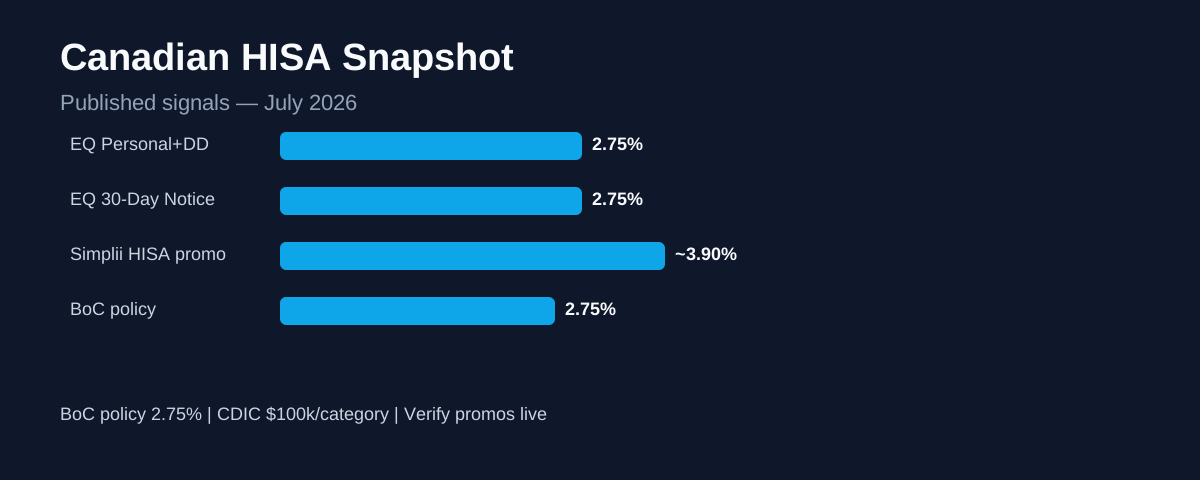
On July 13, 2026, the Bank of Canada policy rate stands at 2.75% (held at the June 10 announcement). That anchor explains why Big Six savings tiers still lag digital challengers, but promotional HISA campaigns remain aggressive for new deposits.
EQ Bank (Equitable Bank, CDIC member) publishes a 2.75% with qualifying $2,000/month direct deposit (1.00% base + 1.75% bonus) on its Personal Account when payroll conditions are met; its 30-Day Notice account shows 2.75% (rates page effective June 11, 2026). Simplii Financial and Tangerine continue to rotate short-term promo rates — around 3.90% on High Interest Savings (check simplii.com for live promo); promotional savings offers often near 4–5% for new clients (verify current promo on tangerine.ca).
| Institution / product | Published rate signal | Insurance | July 2026 note |
|---|---|---|---|
| EQ Bank Personal (with DD) | 2.75% with qualifying $2,000/month direct deposit (1.00% base + 1.75% bonus) | CDIC $100k/category | Needs ≥$2,000/mo recurring deposit |
| EQ 30-Day Notice | 2.75% | CDIC | Liquidity trade-off vs daily savings |
| Simplii HISA | ~3.90% promo tier | CDIC via CIBC | Confirm live promo before transfer |
| Tangerine Savings | Promo-driven | CDIC via Scotiabank | Often best for new money only |
| Big Six standard savings | Often <1% base | CDIC | Bundle or premium chequing may lift tier |
CDIC covers eligible deposits up to $100,000 per insured category per member institution. Splitting larger balances across members is legitimate planning — not a substitute for reading each product's disclosure on transaction limits, holds and promotional expiry dates.
Before moving payroll, compare after-promo rates, e-transfer limits and whether you need a linked chequing account. A 0.5% gap on $50,000 is $250 per year — worth an hour of comparison when BoC is on hold at 2.75%.