

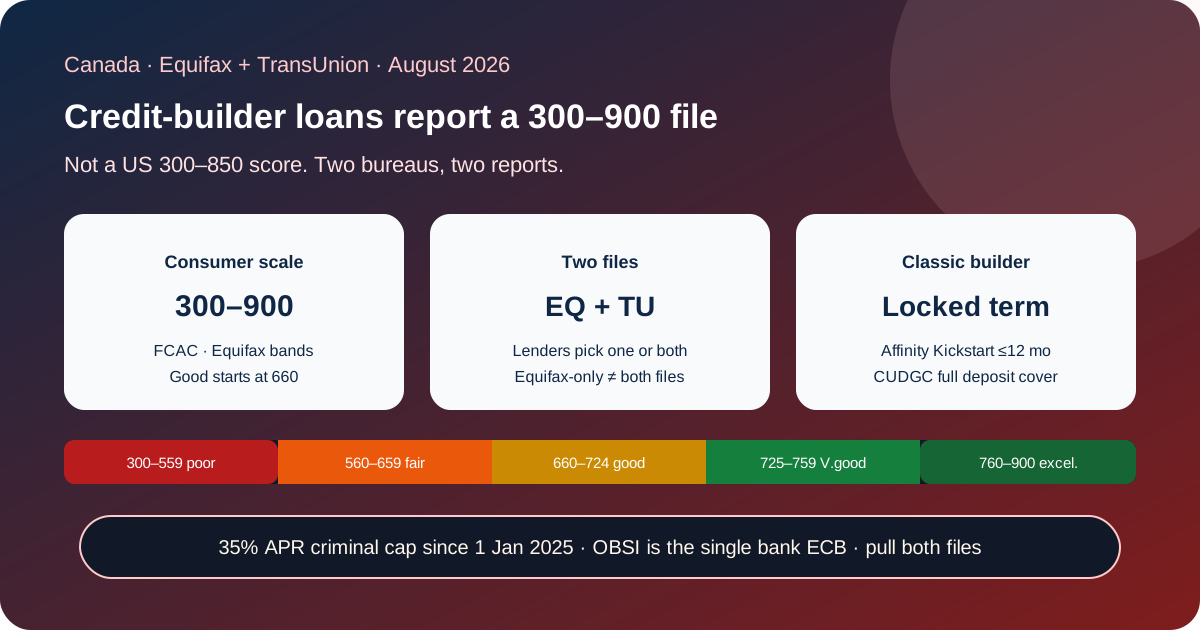
CA-REDO-CREDITBUILDER-20260819Canadian lenders do not score you on a US 300–850 file. They pull Equifax Canada, TransUnion Canada, or both, and the consumer scale the Financial Consumer Agency of Canada describes is usually 300 to 900. A credit-builder loan only moves that number if the lender actually reports the instalment to the bureau a future bank will read — and most Big Six banks do not sell a locked-fund credit-builder at all.
Two bureaus, one 300–900 scale
FCAC is blunt: Canada has two main consumer bureaus, Equifax and TransUnion, and they only store Canadian credit activity. Each lender chooses which file to report to and which file to buy. Neo Financial, for example, has said publicly that it evaluates some cards on TransUnion alone. A mortgage desk can pull the other file. That is why a “score app” screenshot is not the number that prices a personal loan or a first mortgage.
Equifax Canada’s own consumer guide (still current in 2026) treats 660–724 as good, 725–759 as very good, and 760+ as excellent, with “poor” generally below 560. Scotiabank publishes a parallel TransUnion map that does not use the same cut-offs — 660 Equifax is not 660 TransUnion. Mortgage desks often start getting comfortable around 680; that is lender policy, not a statute. The older lender-facing Equifax label you will still hear from brokers is a Beacon score: same 300–900 Canadian range, a different model than the educational number in a free app.
Typical Equifax-style weights — the reason a credit-builder exists — are about 35% payment history, 30% amounts owed / utilization, 15% length of history, 10% credit mix and 10% new inquiries. A locked instalment does nothing to utilization. It can add mix and, if you never miss, payment history. TransUnion’s consumer models rank those same ideas by influence instead of fixed percentages.
| Equifax Canada band | Score | What a prime desk usually does |
|---|---|---|
| Poor | 300–559 | Decline or send you to a secured product |
| Fair | 560–659 | Price up, ask for a co-signer, or both |
| Good | 660–724 | Standard unsecured products start to open |
| Very good | 725–759 | Competitive pricing on cards and loans |
| Excellent | 760–900 | Best advertised rates, if income and TDSR also work |
The pie is the educational Equifax-style split, not a secret lender scorecard. A credit-builder is built for the 35% and the 10% mix slice. It cannot fix a maxed card that is eating the 30%.
What a Canadian credit-builder actually is
The classic design is cash-secured: the lender books an instalment, parks the principal in a term deposit or GIC, you pay blended instalments, each on-time hit is reported, and the deposit is released when the loan and the term both end. Affinity Credit Union’s Kickstart Credit Builder Loan is the clean public example. Affinity (Saskatchewan) puts the advance into a term deposit or a TFSA term deposit, customises the amount so the blended monthly payment is payable, and gives you up to 12 months. Because the loan is fully cash-secured they advertise their best rate, not a distress APR. Two locks matter: the deposit cannot be redeemed until the loan is paid, and even then it waits for the term’s maturity date.
Fintechs sell a different animal. Borrowell’s Credit Builder is an instalment you pick at $5, $15 or $25 every two weeks for 48 months, no interest line, a flat program fee, no hard check at apply, cancellable. It reports to Equifax Canada only and is not offered in Saskatchewan. KOHO’s credit-building add-on is a $225 line of credit on a $5 / $7 / $10 monthly plan: you set a utilization target in the app, it resets after the billing date, and KOHO also reports Equifax only. Spring Financial’s Foundation is a 12-month program that aims to hold $750 in savings and says it reports to both bureaus; the bi-weekly debit is confirmed at enrolment (public pages have quoted more than one figure, so treat the enrolment screen as the contract).
| Product (Aug 2026) | Structure | Reports to | Cash you can spend now? |
|---|---|---|---|
| Affinity Kickstart | Loan + locked term / TFSA term, ≤12 months | Credit bureaus (member product) | No — deposit waits for payoff and maturity |
| Borrowell Credit Builder | $5 / $15 / $25 biweekly × 48 months | Equifax only | No cash-out; not available in Saskatchewan |
| KOHO credit building | $225 line, $5–$10 / month plan | Equifax only | Only inside the $225 KOHO line |
| Spring Foundation | 12 months, ~$750 held savings | Equifax and TransUnion | No — savings released after the program |
| Refresh Financial | Former GIC-backed loan, 19.99% APR historically | — | Products withdrawn; do not apply |
Refresh Financial’s old Cash Secured Savings Loan ($1,250–$10,000, 36–60 months, 19.99% APR in archived reviews) is gone. Loans Canada marks the brand unavailable. Do not use a 2023 blog as a 2026 application path.
The Equifax-only trap
Borrowell’s own 2022 study of Credit Builder members with an Equifax ERS 2.0 score under 600 and an average loan around $240 advertised a 41-point average lift in five months — on Equifax, for people who paid on time. That is a vendor study, not a promise, and it says nothing about TransUnion. If the next underwriter is a Big Six mortgage team that buys the other bureau, you spent a year thickening the wrong file. Pair an Equifax-only program with a product that reports to TransUnion (a credit-union instalment, a card that reports both, or Spring if you accept its fee) or pull both reports before you celebrate.
FCAC’s improvement page still pushes utilization under 30%. A $225 KOHO line can help that ratio if you keep the drawn amount small; a locked Affinity deposit cannot. A Canadian credit-score explainer is the place to walk the two files; this page is only about whether the instalment is worth the fee.
Big Six availability — the honest map
TD, RBC, Scotiabank, CIBC, BMO and National Bank of Canada will happily sell a newcomer package, a secured or starter card, a line of credit once the file exists, or a conventional instalment loan if you already qualify. They do not, on their current Canadian product pages, sell the US-style “we hold $1,000 in a savings account while you pay it back” credit-builder. Comparison sites that list a BMO Credit Builder with a $75 processing fee are recycling a BMO Bank N.A. US program. BMO Canada’s public newcomer path is NewStart-style accounts and cards, not a locked GIC loan.
What the Big Six actually use for thin files: RBC Newcomer Advantage (chequing waiver plus a starter card with no Canadian history), Scotiabank StartRight (newcomer card and package), TD’s newcomer program, CIBC Welcome to Canada. Limits and fee-waiver months change; read the live product page, not a 2024 round-up. For students, the cheaper first tradeline is often a student card or a government student loan that already reports, not a fintech fee.
Price, the 35% cap, and who insures the locked cash
Since 1 January 2025 the Criminal Code treats interest above 35% APR as a criminal rate on consumer-size loans (the old 60% EAR / ~48% APR test is gone). A “no interest, just a fee” credit-builder still has a cost of borrowing. Convert the program fee into an APR on the money you cannot spend before you sign. If the fee on a few hundred dollars locked for a year is fat, a credit-union Kickstart at the member’s best secured rate is usually cheaper — and it reports an instalment the old-fashioned way.
Locked cash at a federal bank or trust sits under CDIC: $100,000 per insured category, principal plus interest. Affinity is a Saskatchewan credit union. Its term deposit is guaranteed by the Credit Union Deposit Guarantee Corporation (CUDGC) for the full amount — no $100,000 ceiling. That is a better insurance story than CDIC for a large TFSA term, and it is also why you should not treat a fintech “held savings” pot as a CDIC deposit unless the contract names a CDIC member as custodian. Compare the term itself with current GIC rates at Canadian banks: a Kickstart that earns the credit union’s term rate while it reports is a different product from a $10/month Equifax-only subscription that earns nothing.
Provincial age of majority is 18 or 19. You need a SIN for bureau reporting. Credit unions require membership (Affinity is Saskatchewan-focused). Borrowell excludes Saskatchewan. None of that is a hard-score floor — these products exist because the score is thin or ugly — but income still has to service the debit. A missed payment on a product whose only job is payment history is the most expensive way to use it.
If the file is wrong, or the lender stalls
Pull both reports. FCAC’s “Getting your credit report and credit score” page lists the official Equifax and TransUnion channels; the no-upsell path is still a mailed request with photocopies of two pieces of ID. Published consumer numbers: Equifax Canada 1-800-465-7166 (Box 190, Jean Talon Station, Montreal, QC H1S 2Z2) and TransUnion Canada 1-800-663-9980 (P.O. Box 338, LCD1, Hamilton, ON L8L 7W2). Checking your own file is a soft inquiry.
PIPEDA plus provincial reporting statutes give the bureau about 30 days to investigate a written dispute. Do not mail a US “section 609 / FCRA” template — it has no force here and some shops will bin it. If a federally regulated bank caused the bad line, the bank has 56 days under the Financial Consumer Protection Framework; after that (or if you dislike the answer) the single external complaints body since 1 November 2024 is the Ombudsman for Banking Services and Investments (OBSI), with 120 days once it accepts the file. ADRBO is no longer the live ECB. FCAC supervises the system; it does not decide your file. Bureau conduct also sits with the provincial consumer ministry that licenses the agency, the Office of the Privacy Commissioner, and in Quebec the Credit Assessment Agents Act.
FCAC retention, for the negatives a builder is trying to age off: late payments and collections up to 6 years; lender inquiries 3 years at Equifax, up to 6 at TransUnion; first bankruptcy usually 6 years after discharge (TransUnion 7 in Ontario, Quebec, PEI and Newfoundland and Labrador); a second filing 14 years; a consumer proposal the earlier of 3 years after it is paid or 6 years after it was signed. Positive closed accounts: up to 10 years at Equifax, up to 20 at TransUnion. A builder does not erase those clocks. It only adds new on-time lines while they run.
Affinity’s two locks, CUDGC, and the 35% APR test — 18 August 2026
Affinity’s Kickstart is still the rare Canadian credit-builder you can read on the lender’s own site. The advance goes into a term deposit or a TFSA term deposit. Blended payments run up to twelve months. The deposit does not unlock when the last debit clears — it unlocks on the later of full payoff and the term’s maturity date. That second lock is the part blogs skip. If you need the cash in month ten, this is the wrong product; if you wanted a GIC anyway, the reporting is a side-effect you are paid (a little) to take.
Saskatchewan CUDGC still guarantees every dollar on deposit at a provincial credit union, with no $100,000 cap. A Big Six GIC of the same size is CDIC to $100,000 per category. Fintech “held savings” are only as safe as the named custodian in the contract. Since 1 January 2025 any consumer-size credit-builder whose all-in cost of borrowing prints above 35% APR is on the wrong side of the Criminal Code — convert the program fee before you treat “no interest” as cheap.
Who this is actually for
Use a cash-secured credit-union instalment if you can join, you want both a deposit and a tradeline, and you can live without the cash until maturity. Use Borrowell or KOHO only after you have decided that an Equifax-only line is the gap — for example you already have a TransUnion-reporting card. Use Spring only after you have converted the 12-month debit into a real APR and accepted that the $750 is savings you already paid in. Skip the whole category if your problem is utilization on existing cards or a collection that is still inside the six-year window: pay those first. A credit-union loan page is the next stop if Kickstart-style membership is the better fit.
Before you add a second builder, pull both Equifax Canada and TransUnion Canada. An Equifax-only subscription that has already aged six months will not rescue a thin TransUnion file a mortgage desk is about to buy. If Kickstart is the path, confirm membership, the term’s maturity, and the blended payment against the same month’s rent and existing instalments. If a bureau line is simply wrong, start the PIPEDA dispute and the 30-day clock — do not buy another tradeline to drown a reporting error that the creditor should delete.