


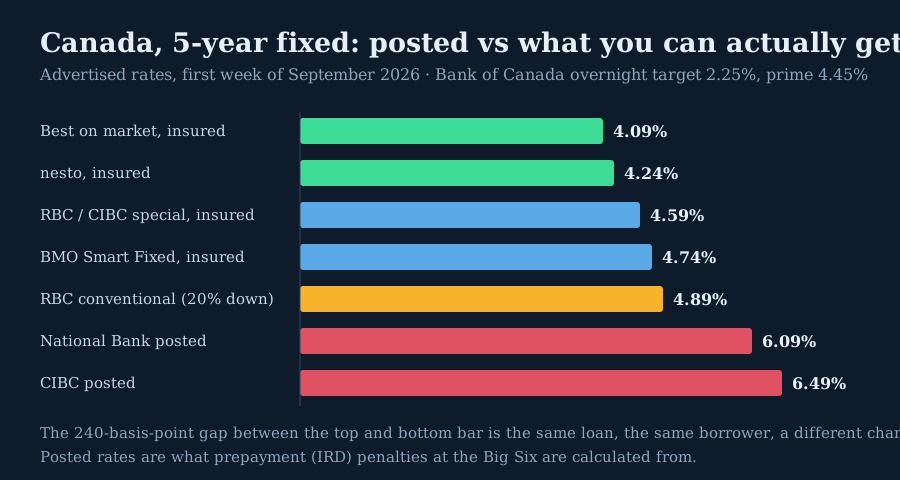
On 7 September 2026 the lowest advertised five-year fixed mortgage rate in Canada is 4.09% for an insured (high-ratio) mortgage through a broker, and the lowest five-year variable is 3.30%. The Big Six banks are quoting 4.59%-4.89% on their five-year fixed specials while their posted rates for the same term still read 6.09%-6.49%. The Bank of Canada held its overnight target at 2.25% on 2 September 2026 — the seventh consecutive hold — so prime has sat at 4.45% since the last cut on 29 October 2025 (TD prices its own mortgage prime at 4.60%).
The spread between the best rate on the market and the one your bank offers you at renewal is worth roughly $19,100 over a single five-year term on a $500,000 mortgage. That number, not the headline rate, is what this page is about: where the gap comes from, which of it you can actually claim, and the three Canadian rules (insurable pricing, the stress test, the straight switch) that decide whether the 4.09% is available to you at all.
Advertised five-year rates, September 2026
Rates below are the special/discounted offers each lender was publishing in the first week of September 2026, separated into insured (down payment under 20%, default insurance paid by the borrower) and conventional/uninsured (20% or more down). Posted rates are shown because they are not decoration — they drive prepayment penalties.
| Lender | 5-yr fixed, insured | 5-yr fixed, conventional | 5-yr fixed, posted | 5-yr variable |
|---|---|---|---|---|
| Best on market (broker/monoline) | 4.09% | 4.74% | — | 3.30% |
| Perch | 4.14% | — | — | 3.50% |
| nesto | 4.24% | — | — | 3.45% (prime − 1.00%) |
| Canwise | 4.54% | — | — | — |
| RBC | 4.59% | 4.89% | — | 3.65% insured / 3.95% conventional |
| CIBC | 4.59% | — | 6.49% | 3.65% |
| First National | 4.64% | — | — | — |
| National Bank | 4.69% | — | 6.09% | 4.35% (posted) |
| MCAP | 4.74% | — | — | — |
| BMO (Smart Fixed) | 4.74% | 4.84% | 6.09% | 4.10% (amort. ≤25 yrs) |
Read the first and the last bank rows together. The distance between 4.09% and 4.74% is 65 basis points on products that are legally identical — the same CMHC-insured loan, the same house, the same borrower. Nothing about your file changes between those two rows; only the channel does.
Why the posted rate matters even though nobody pays it
No borrower with a pulse signs at 6.49%. The posted rate survives because two things are calculated from it. The first is the renewal letter: banks routinely mail a rate far above their own best offer, and more than 70% of Canadian homeowners sign it without shopping. The second is the penalty for breaking a closed fixed mortgage early.
That penalty is the greater of three months’ interest or the interest rate differential (IRD). At the Big Six the IRD is built from posted rates: the bank takes the posted rate in force when you signed, subtracts the discount it gave you, and compares the result with today’s posted rate for the remaining term. Because posted rates are held roughly two percentage points above real ones, the "differential" the bank claims to lose is inflated, and the bill routinely runs into five figures. Monoline and broker lenders more often calculate the same penalty from their actual contract rates, which is a difference you only discover in the year you need to move.
Practical consequence: if there is any chance you sell, refinance or restructure before the term ends, the penalty formula in the commitment letter is worth more than 10 or 15 basis points on the rate itself. Ask for it in writing before you sign, in the same conversation where you ask about a home equity line of credit being registered behind the mortgage.
The 20% down payment trap: insured is cheaper than uninsured
Canada prices mortgages backwards compared with what most people expect. A borrower putting less than 20% down pays CMHC default insurance and gets the lowest rate on the board. A borrower putting 20% or more down carries the credit risk for the lender and pays more: 30 basis points more at RBC (4.89% conventional against 4.59% high-ratio), 10 basis points at BMO, and up to 50 basis points among brokers (4.74% against 4.24%).
The mechanism is funding, not fairness. An insured mortgage carries a federal government guarantee, so the lender can pool it into National Housing Act mortgage-backed securities that pension funds buy at very low yields. The lender funds that loan more cheaply and hands part of the saving back. A conventional mortgage has no such guarantee, costs the bank capital, and is priced accordingly.
A borrower with 20% down is not shut out of the cheap tier. Lenders buy bulk portfolio insurance themselves — at no cost to you — and pass on insurable pricing, provided the file fits the federal insurance rules:
- Amortization 25 years or less. Choose 30 years and the mortgage becomes uninsurable, which is why BMO prices its 30-year-amortization variable at 4.20% and its 25-year one at 4.10%.
- Property value under $1.5 million. At $1,500,000 or more nothing is insurable, and 20% down becomes mandatory.
- Purchase or straight-switch renewal only. Any refinance — equity takeout, debt consolidation, increasing the loan — is uninsurable by definition.
- Owner-occupied. Rentals and investment properties do not get this pricing.
So the real question at the offer stage is not "fixed or variable" but "does my file still qualify as insurable". A 30-year amortization taken for comfort can cost more in rate than it saves in monthly payment.
September 2026 update: arrears are rising, but slowly
The renewal wave has started to show up in the delinquency data, and the size of the move is the point. Mortgages 90 or more days in arrears at Canada’s chartered banks reached 0.28% in Q1 2026, up from 0.22% a year earlier. That is a 27% relative increase, and it takes the national rate back to roughly its 2019 pre-pandemic average of 0.24%-0.28% rather than to anything resembling a crisis. Saskatchewan was the weakest province at 0.41% in Q4 2025.
| Mortgage arrears, 90+ days | Rate |
|---|---|
| Chartered banks, Q1 2026 | 0.28% |
| Chartered banks, Q1 2025 | 0.22% |
| Pre-pandemic average (2019-2020) | 0.24% |
| Saskatchewan, Q4 2025 (worst province) | 0.41% |
The reason the number is not worse is that borrowers have been absorbing the shock through amortization rather than through default. The average remaining amortization in Canada now runs about 16 months longer than before the pandemic. Of the roughly 10% of 2022 mortgage holders who have refinanced since, 70% extended their amortization, by an average of six years. Bank of Canada simulations show that about half of all borrowers facing a renewal increase could erase it entirely by adding five years to the remaining schedule.
What CMHC insurance costs in 2026
The premium is a percentage of the loan, added to the mortgage rather than paid in cash, and it rises steeply with loan-to-value:
| Loan-to-value | Premium (amortization ≤25 yrs) | With 30-year amortization |
|---|---|---|
| up to 65% | 0.60% | 0.80% |
| 65.01% - 75% | 1.70% | 1.90% |
| 75.01% - 80% | 2.40% | 2.60% |
| 80.01% - 85% | 2.80% | 3.00% |
| 85.01% - 90% | 3.10% | 3.30% |
| 90.01% - 95% | 4.00% | 4.20% |
The 30-year column is the standard schedule plus the 0.20% surcharge that applies to insured 30-year amortizations. Increasing an existing insured loan through a blended amortization carries a separate 0.60% surcharge on the increase.
Worked example. A $600,000 home with the legal minimum down payment: 5% of the first $500,000 ($25,000) plus 10% of the remaining $100,000 ($10,000) = $35,000 down, a $565,000 loan at 94.2% LTV. The premium is 4.00% = $22,600 over 25 years, or 4.20% = $23,730 if you stretch to 30 years. Stretching costs $1,130 up front and buys a payment of $2,830 instead of $3,120 at 4.09% — $290 a month of relief paid for with five extra years of interest.
Down payment and the $1.5 million line
The minimum down payment is 5% on the first $500,000 of the price and 10% on the portion between $500,001 and $1,499,999. On a $1,200,000 home that is $25,000 plus $70,000 = $95,000. From $1,500,000 the insurance ceiling closes and the minimum jumps to a full 20%, which is a $300,000 cliff at the price point where Toronto and Vancouver detached listings sit.
Thirty-year insured amortizations, reopened on 15 December 2024, are not for everyone: first-time buyers qualify on any property, resale or new, while repeat buyers qualify only on newly built homes. A move-up buyer purchasing a resale house is still capped at 25 years.
The stress test you actually have to pass
Under OSFI Guideline B-20 you must qualify at the greater of your contract rate plus 2.00% or the 5.25% benchmark floor. At today’s rates the floor is dormant: it would only bind on a contract rate below 3.25%, and the best five-year fixed offers sit at 4.0%-4.3%. In practice buyers are being qualified at 6.0%-6.3% — roughly two points above what they will actually pay.
The exemption worth knowing is the straight switch, introduced by OSFI on 21 November 2024. An uninsured borrower moving to a new federally regulated lender at renewal no longer has to re-qualify at the minimum qualifying rate, provided the balance is unchanged (an allowance of up to $3,000 exists purely to cover transfer fees), the remaining amortization is not extended, and both lenders are federally regulated. Before that change, a household whose income had not kept up with the stress test was effectively captive to its own bank at renewal. It is no longer, and that is the single most valuable rule on this page for anyone renewing in 2026.
The 2026 renewal wave in numbers
Around 60% of all outstanding Canadian mortgages come up for renewal across 2025 and 2026 — more than $1.46 trillion out of $2.442 trillion of residential mortgage debt outstanding as of June 2026. The people renewing signed at pandemic-era rates near 2%, and they are being repriced at roughly 4.5%-4.7%.
What that does to a payment, using the Bank of Canada’s own worked case: a $450,000 balance coming off 2.19% onto 4.69% with 20 years of amortization left moves from $2,315 to $2,882 a month — +$567, a 24% increase, permanent for the whole term.
Against $567 a month, the effort of getting quotes is trivially worth it — and this is exactly where the posted-rate renewal letter does its damage. Take the same $500,000 mortgage over 25 years: at 4.09% the payment is $2,654.55, at 4.89% it is $2,876.79. Over one five-year term that is $13,335 in extra payments and $5,819 more still owed at the end, because less of each payment went to principal: $19,154 for 80 basis points.
Fixed or variable when variable is cheaper
The usual Canadian trade-off is reversed right now. Variable is not only the flexible option, it is the cheap one: 3.30%-3.65% against 4.09%-4.59% fixed. On a $500,000 mortgage over 25 years, 3.30% costs $2,443.86 a month against $2,654.55 at 4.09% — $211 a month in your favour from day one, with no forecast required.
Fixed rates are priced off the five-year Government of Canada bond, which was at 3.26% on 26 August 2026 after touching a twelve-month high of 3.36% on 21 August — a move that pushed lenders to raise fixed rates twice in one week. A year earlier the same yield was 2.73%. Lenders add roughly 100-200 basis points on top (the Bank of Canada uses 150 in its own simulations), which is why 4.1%-4.6% is where fixed rates land.
The variable side depends on the policy rate, and the market has stopped pricing cuts. CORRA swaps at the end of August 2026 implied a 25-basis-point hike to 2.50% with a coin-flip probability at the 9 December 2026 decision, rising to near-certainty by 27 January 2027, and a terminal rate around 3.25% by the end of 2027. The next scheduled announcement is 28 October 2026.
That gives a clean decision rule instead of a forecast. Your variable discount today is roughly 75-100 basis points. Variable wins for the whole term as long as the Bank of Canada hikes by less than that discount. If the full 100 points priced into the curve arrive by 2027, a variable taken today ends the term at about the rate you could have locked in September 2026 — you break even, having paid less for two years and more for three. If the economy stalls and the hikes do not come, variable wins outright. A borrower who cannot absorb $211 a month moving the wrong way should not be in that trade regardless of the arithmetic; one who can is being paid to wait. The mechanics of how those payment adjustments work are covered in more detail on our page about adjustable-rate mortgages.
Canadians have already voted. Of newly extended mortgages at chartered banks in June 2026, 36% were variable (down from a 42% peak earlier in the year, up from 5% in late 2023), 39% were fixed terms of three to under five years, and only 10% were fixed for five years or longer — against 45%+ in the pandemic era. CIBC reports three-year terms above 40% of its originations and five-year terms down to 17%. The five-year fixed, the product this page is named after, is now a minority choice.
What to do with this before you sign
- Ask for the insurable status of your file in writing. Down payment, amortization, price and occupancy decide whether 4.09% or 4.89% is even on the table for you.
- Do not treat the renewal letter as an offer. It is a posted-rate anchor; two competing quotes typically move it 50-80 basis points.
- If you are uninsured and renewing, price a switch. Since November 2024 you no longer re-qualify at 6.0%-6.3% to move lenders on identical terms.
- Get the prepayment penalty formula before the rate. Posted-rate IRD at a Big Six bank can erase several years of a 20-basis-point saving in one transaction.
- Match the term to your horizon, not to habit. With the curve pricing hikes into 2027, a three-year fixed or a variable with a 75-100 point discount are the two defensible positions; a five-year fixed at 4.6% is a premium for certainty you should choose deliberately.
- Keep the down payment above the LTV band edges. Moving from 90.01% to 90.00% LTV cuts the CMHC premium from 4.00% to 3.10% of the loan — worth thousands for a few hundred dollars of extra down payment.
Rates on this page are the advertised specials of the first week of September 2026 and change weekly with the bond market; the structural rules — insurable pricing, premium bands, the stress test, the straight switch — change far more slowly and are what actually determine which rate you are allowed to have. If your plan is to park a down payment for another year first, compare where that money sits on our GIC rates page, since a locked-in GIC maturing after your closing date is a common and expensive scheduling mistake.
That option is not free and it is not universally available. Extending the amortization on an insured mortgage past 25 years moves you into the surcharged premium band, and for a conventional borrower it forfeits insurable pricing altogether, which is worth up to 50 basis points on the rate. It also converts a temporary cash-flow problem into permanent interest: five extra years of payments buys relief now at a cost measured in tens of thousands over the life of the loan. The order to try things in is therefore: shop the rate first, switch lenders if the quote is better, and only then reach for the amortization lever.
One group cannot use the first two steps. The Bank of Canada estimates that about 4% of mortgage borrowers nationally, and 9% in the Toronto area, have loan-to-value and debt-service ratios that would fail a refinance at 2027 rates and prices. They can still renew with their existing lender, and since November 2024 an uninsured borrower in that position can also make a straight switch to a competitor without re-qualifying — which is precisely why comparing the renewal letter against two outside quotes matters most for the households that feel they have the least room to negotiate.