

BUSINESSCREDIT-CA-20260927Getting business credit in Canada is easier than most owners expect and more personal than most would like. Federal data published by Innovation, Science and Economic Development Canada (ISED) in July 2026 shows 97% of small businesses that asked for debt financing in 2025 were approved, at an average rate of 5.8%, down from 9.0% in 2023. The catch sits in the fine print: almost every small-business loan is underwritten on the owner, and even the government-backed Canada Small Business Financing Program (CSBFP) lets the lender take your personal guarantee for up to the full original loan amount.
So the real question is not whether a lender will say yes. It is which route gives you the size, term and security terms your business can live with, and how much of your personal balance sheet you put behind it. The table below lines up the options that are actually open to a Canadian small business in September 2026, with the limits taken from the programs' own pages.
The routes side by side
| Route | How much | What it costs | Who it fits | Watch for |
|---|---|---|---|---|
| Conventional bank line of credit or term loan | Set by the lender | Priced off the bank's prime rate (4.45% at the Big Six in September 2026) plus a negotiated margin | Businesses with two or more years of statements and steady cash flow | General security agreement over business assets and a personal guarantee are standard |
| CSBFP term loan (through a bank or credit union) | Up to $1,000,000; no more than $500,000 for equipment and leasehold improvements, and $150,000 for intangibles and working capital | Ceiling of lender's prime + 3% floating, or its residential mortgage rate + 3% fixed; 2% registration fee; 1.25% yearly administration fee built into the rate | Start-ups and firms with gross revenue of $10 million or less buying equipment, premises or leaseholds | Unsecured personal guarantee allowed up to the original loan amount |
| CSBFP line of credit | Up to $150,000 (total program ceiling $1.15 million per borrower) | Ceiling of prime + 5%, plus the 2% registration fee on the authorized limit | Working capital for a firm that already has, or also takes, a term loan | Five-year term, then renewal, conversion to a term loan of up to 10 years, or repayment |
| BDC Small Business Loan (online) | Up to $100,000, or up to $350,000 on the larger track | No application or prepayment fees up to $100,000; fees apply above that | Profitable firms, 24 months in business, $100,000+ revenue ($250,000+ for the larger track), owner credit score 600+ | Interest-only for up to 6 or 12 months, then amortization over 5 or up to 8 years |
| BDC Pivot to Grow (liquidity stream, from August 25, 2026) | $250,000 to $5 million | 0% interest for the first 12 months, interest-only for 36 months, 96-month amortization | Exporters hit by the U.S. tariffs of August 22, 2026, with at least $1 million in revenue | Aimed at trade-disrupted firms, not general start-up funding |
| Futurpreneur with BDC | Up to $75,000 ($25,000 Futurpreneur plus up to $50,000 from BDC) | Floating rates set by each lender; interest-only in the first year on the BDC part | Founders aged 18 to 39, including pre-revenue start-ups | Comes with up to two years of mandatory mentorship |
Two rows on that table are often misunderstood. CSBFP money is not a government grant or a government loan: the bank or credit union lends its own funds and makes the credit decision, and Ottawa shares the loss if you default. And the BDC online loan is built for established, profitable companies, so a founder with a year of trading will usually be steered to a CSBFP loan or to Futurpreneur instead.
What borrowing actually costs right now
The Bank of Canada held its policy rate at 2.25% on September 2, 2026, its seventh hold in a row, and the next decision is due on October 28. Chartered banks have kept prime at 4.45% since late 2025, which matters because nearly every small-business line of credit in Canada floats on prime. A one-point move in prime moves the interest on a fully drawn $100,000 line by about $1,000 a year.
ISED's credit-condition series tracks the average rate small businesses actually paid, and the fall since the 2023 peak is steep:
Source: ISED, Small Business Credit Condition Trends 2015–2025 (updated July 14, 2026). The same report puts the 2025 approval rate at 97%, up from 89% in 2024, while only about one small business in five asked for debt at all.
A CSBFP equipment loan in dollars
Take a café owner financing $300,000 of kitchen equipment and leasehold improvements through a CSBFP term loan at a bank whose prime is 4.45%. The most the lender can charge on a floating loan is 7.45%. Over 10 years that ceiling works out to a monthly payment of roughly $3,550, about $126,000 of interest over the life of the loan. The 2% registration fee adds $6,000 at the start; you can pay it or roll it into the loan, and rolling it in lifts the payment by about $70 a month.
The ceiling is a maximum, not a price list. Lenders compete below it, so a borrower with clean statements and a strong personal file should ask what margin over prime the bank is offering and whether a conventional loan would be cheaper than the program version. The 1.25% administration fee that the lender pays to the government is already inside the rate, which is why CSBFP pricing can look a little higher than a conventional loan to the same customer.
Some things the program will not pay for. Farms are excluded and use the Canadian Agricultural Loans Act program instead. Inventory cannot be bought with the term loan, only carried on the line of credit. You cannot refinance something the same lender already financed on a conventional loan, and assets must have been bought within 365 days before the loan is approved. Goodwill qualifies only as part of buying a going concern, inside the $150,000 intangibles limit.
The personal guarantee is the real decision
Under current CSBFP rules a lender may take an unsecured personal guarantee up to the original amount disbursed. Outside the program, banks write their own guarantee terms, and nothing stops them from asking for an unlimited guarantee or for security on your home. Before you sign, it is worth asking for three things in writing: a cap on the guarantee, often expressed as a percentage of the loan; a release once the balance falls below an agreed level or the business hits agreed results; and a clear statement of which assets secure the loan, so a general security agreement over the business is not doubled by a mortgage on the family house.
Incorporating does not remove this exposure on its own. A corporation limits liability to trade creditors, but the lender's guarantee reaches straight past it to you, which is also why the owner's personal credit report is part of every small-business file.
Your business credit file versus your personal score
A Canadian business does not get a credit file automatically when it registers with its province or receives a CRA business number. Commercial files at Equifax Canada and Dun & Bradstreet Canada start to build only once suppliers and lenders report payments under the company's legal name. D&B's PAYDEX score runs from 1 to 100, where 80 means you pay suppliers on the due date and higher scores mean you pay early.
For small loans, lenders still lean mostly on the owner's personal score on the 300 to 900 scale used by Equifax and TransUnion in Canada; BDC, for example, publishes a minimum of 600 for its online loan. If your personal file has late payments or maxed-out cards, fixing that first is usually worth more than any business-credit trick, and our guide to how Canadian credit scores are calculated shows what moves the number.
Where small businesses really borrow
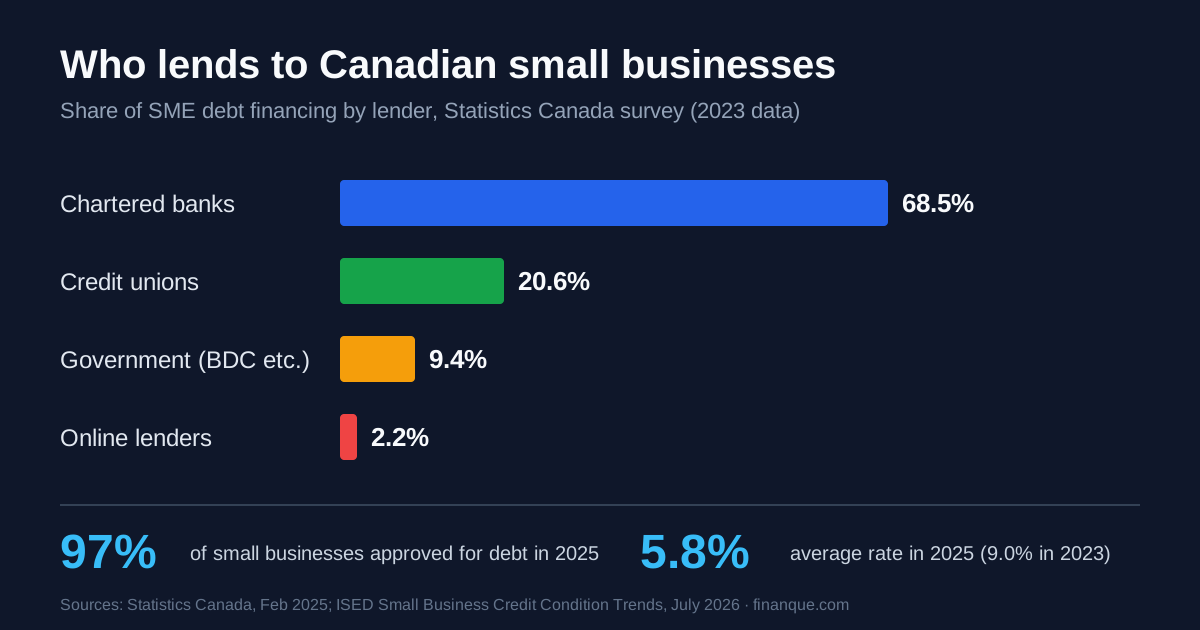
Statistics Canada's survey of small and medium enterprises, covering 2023 and released in February 2025, found that 25.7% of SMEs requested debt financing and 88.2% had their largest request fully or partly approved, for about $94.0 billion in total. Chartered banks supplied 68.5% of that debt, credit unions 20.6%, government institutions such as BDC 9.4%, and online alternative lenders only 2.2%.
The most requested product was not a loan at all. Business credit cards were requested by 12.1% of SMEs, lines of credit by 10.2%, term loans by 7.3% and non-residential mortgages by 3.2%. Cards are convenient for purchases you clear each month, but they are the most expensive way to carry a balance, so recurring shortfalls belong on a line of credit. For property, a commercial mortgage is the product that fits, and the credit-union share above is a reminder that members of Desjardins in Quebec or of provincial credit unions can apply for CSBFP loans there too.
The legal ceiling on expensive business credit
Since January 1, 2025 the criminal interest rate in section 347 of the Criminal Code is 35% APR, but the Criminal Interest Rate Regulations carve out commercial loans. When the borrower is not an individual and the loan is for business purposes, a loan above $10,000 and up to $500,000 may cost up to 48% APR, and a loan above $500,000 has no criminal-rate ceiling at all. A sole proprietor borrowing in their own name is an individual, so the 35% limit still protects them.
That gap is where online lenders and merchant cash advances operate. A cash advance is often quoted as a factor rate: a $50,000 advance at a factor of 1.25 means repaying $62,500, collected from daily card sales. If that is repaid in six months, the annual cost is several times the 25% the factor suggests. Convert any factor rate or weekly fee into an annual rate before comparing it with a bank or BDC offer, and treat such money as a short bridge, not as working capital you roll over.
What to prepare before you apply
- Two years of financial statements and business tax returns (T2 for a corporation, T1 with business schedules for a sole proprietor), plus interim figures for the current year.
- A personal net worth statement and personal tax returns for every owner who will guarantee the loan.
- Quotes or invoices for the equipment or leaseholds you want to finance; a CSBFP loan is tied to specific eligible assets.
- A cash-flow forecast showing the payment at today's prime and at prime plus one point.
- A short business plan if the company is under two years old or the request is large.
Choose the route by stage. A founder under 40 with a plan but no revenue should start with Futurpreneur. A start-up buying equipment or fitting out premises is the core CSBFP customer, and start-ups are eligible from day one. A profitable company with two years of statements can get a fast answer from BDC or negotiate a conventional line with its bank. An exporter squeezed by the latest U.S. tariffs should ask BDC about Pivot to Grow first. Owners who are tempted to cover business swings with a personal line of credit should know that it blurs the company's records and puts the debt in their own name from the first dollar.